 JAPANDIWOVEN
Chinese Bamboo Weaving: An Ancient Living Heritage
The Architecture of a Mountain Grass
Long before it became recognized as national intangible cultural heritage, bamboo weaving was a direct answer to geographic reality. In the karst river valleys and misted slopes of southern China, particularly across Guangxi, bamboo is neither tree nor garden ornament; it is a structural grass of immense tensile strength. For thousands of years, rural communities observed how its tubular culms bend in torrential monsoons without breaking, resisting decay while remaining exceptionally lightweight.
To harvest bamboo for weaving requires an intimate literacy of the natural calendar. Artisans do not harvest green shoots or old, brittle stalks. The ideal culm is typically between three and four years old, gathered in late autumn or early winter when the sap drops and the risk of insect damage declines. In both its source materials and the craftsmanship involved, Chinese bamboo weaving represents a magnificent accumulation of human ingenuity, developed not in theoretical isolation, but through daily contact with the earth.
The Precision of the Splitting Knife
The most demanding phase of bamboo craft rarely occurs at the weaving frame. It happens at the bench, where raw timber is reduced to paper-thin filaments through tactile precision. A master craftsman can split a single cylinder of bamboo into dozens of identical strips, relying entirely on the resistance felt against the blade and thumb.
The process follows a strict discipline:
- Scraping the green skin (Ding Qing): Removing the waxy epidermis to prepare the fibers for uniform drying and subtle color aging.
- Radial splitting (Po Zhu): Halving and quartering the cylinder along its natural longitudinal grain using a heavy cleaver.
- Layering (Fen Ceng): Separating the tough outer layer (zhu qing, or bamboo skin) from the softer inner pith (zhu huang, or bamboo meat). The skin provides structural spring, while the inner flesh provides pliable body.
- Sizing and scraping (Gua Si): Drawing each strip through fixed blades to ensure consistent width and thickness, sometimes down to a fraction of a millimeter.
This material economy is foundational to the philosophy of the craft. Nothing is discarded arbitrarily; the thicker inner layers form the under-structures of storage baskets and furniture, while the exterior filaments are reserved for delicate woven surfaces.
Structural Geometries and Human Patience
Once the strips are prepared, the weaving begins. Chinese bamboo weaving encompasses hundreds of distinct patterns, ranging from utilitarian loose-weave sieves to micro-woven decorative screens historically presented to the imperial court. Yet even in its most complex expressions, the logic remains binary: the warp and the weft, tension and counter-tension.
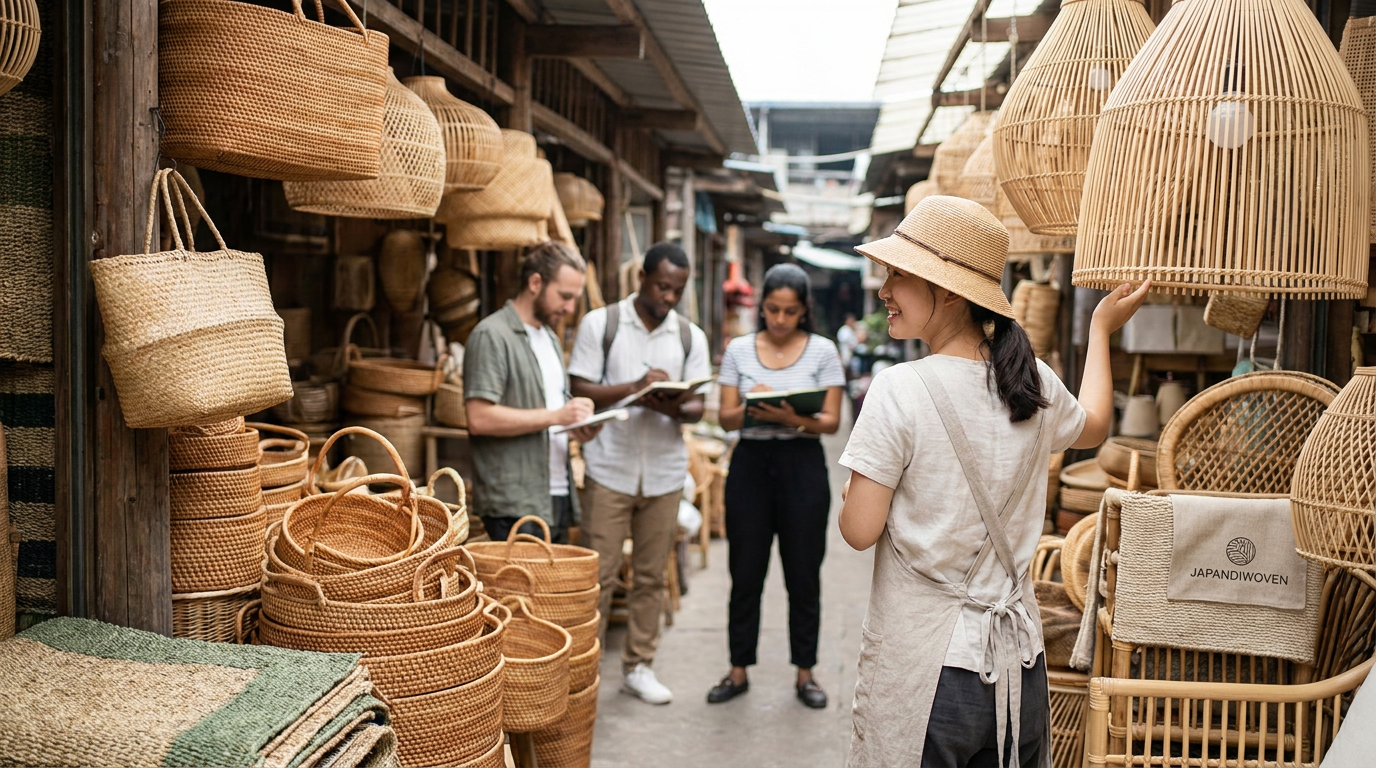
In our Guangxi workshops, the weavers balance geometric rigor with physical memory. Hexagonal openwork allows airflow around dried goods and tea leaves. Tight twill weaves yield impervious trays and stools capable of bearing significant weight. The human hand provides a micro-elasticity that machines cannot replicate; an artisan pulls each strand with a calibrated force that compensates for the natural variation in each individual strip of grass. Over days or weeks of repetitive motion, a three-dimensional vessel rises from a flat bundle of green ribbons.
The Japandi Resonance
For those drawn to Japandi interiors, Chinese woven bamboo offers an intuitive harmony. The style relies on the intersection of Scandinavian functionality and Japanese wabi-sabi—a quiet appreciation for natural materials that carry the imprint of time. Because the craft traditions of East Asia share ancestral roots in timber, reed, and bamboo construction, these objects feel immediately native in pared-back spaces.
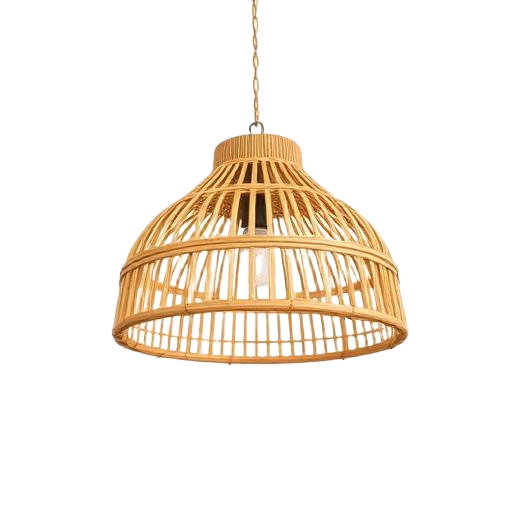
Bamboo does not clamor for attention. Its surface possesses an understated satin sheen that softens artificial lighting and catches morning sun without glare. When paired with unbleached linen, lime-washed plaster, and dark-toned joinery, a woven bamboo pendant or storage chest anchors a room with textural depth rather than ornamental excess. It serves its purpose quietly, holding blankets, filtering light, or storing ceramics with dignified restraint.
Moreover, the material changes with its owner. As the years pass, bamboo naturally shifts from its initial pale straw or celadon undertone toward a rich, warm honey amber. This gentle patina is not a sign of wear, but of quiet endurance.
A Practical Takeaway
When introducing ancient bamboo craft into a contemporary home, simplicity is your best guideline. Select one or two well-made pieces that solve a specific functional problem—such as an open-weave basket for textile storage or a woven shade that diffuses overhead light—and allow them breathing room against a plain wall.
To preserve the fibers, keep bamboo away from continuous direct moisture and harsh heating vents. An occasional wipe with a soft, slightly damp cotton cloth will maintain the natural moisture balance of the strips, ensuring the work of Guangxi’s craftspeople remains resilient for decades to come.