 JAPANDIWOVEN
Small-Space Storage with Handwoven Baskets: A Japanese Home Guide
In Japan, storage is not an afterthought. It is one of the first things a designer thinks about — because when floor space is limited, every object needs a place to belong. The result is a domestic culture that treats organisation as a form of design, not a chore.
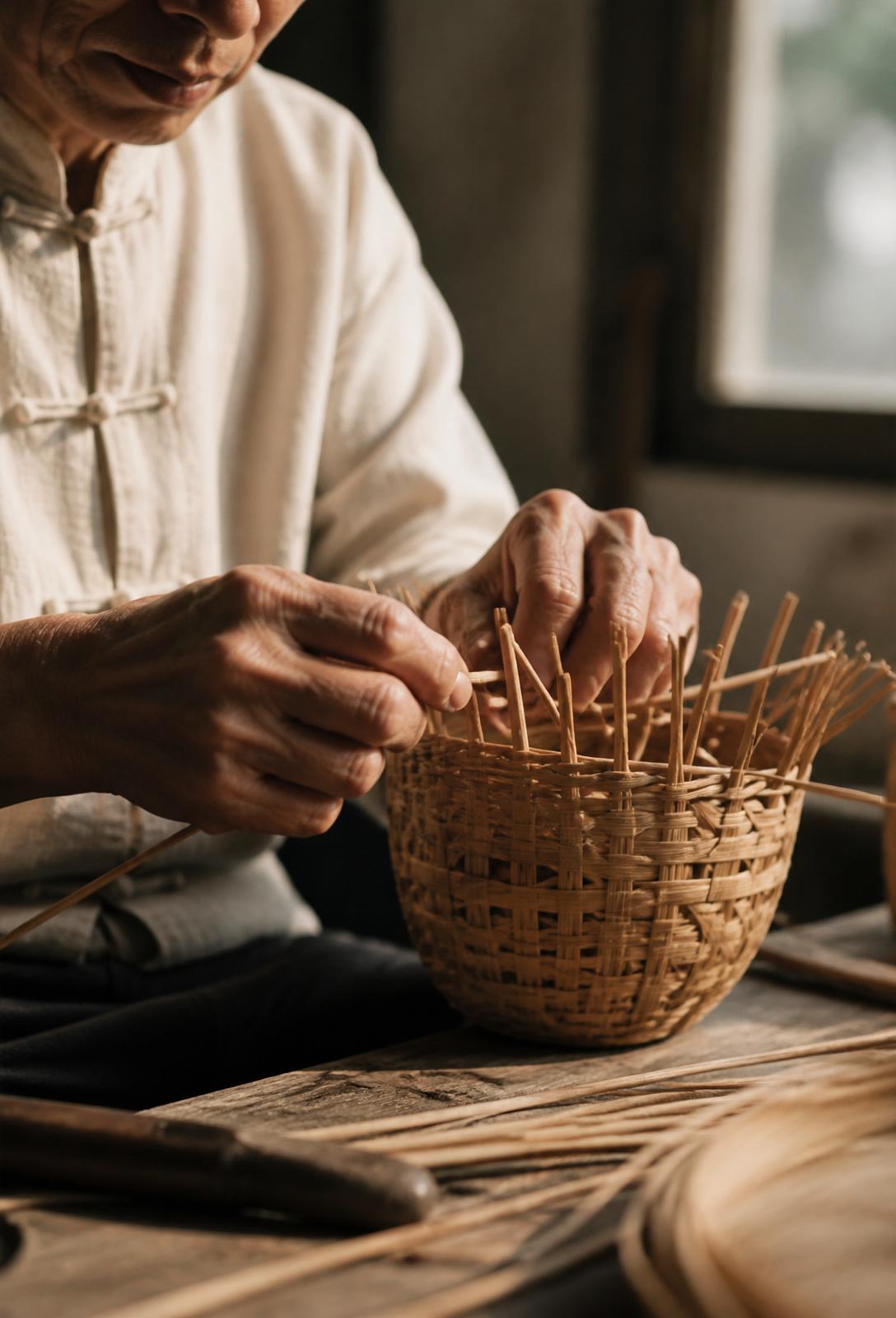
This is one reason handwoven baskets have never fallen out of fashion here. They are not simply containers. They let natural material and visible craft into a room without adding visual weight.
Why handwoven storage suits compact homes
Three qualities make woven baskets unusually well suited to smaller living spaces.
They are visually light. A solid cabinet occupies a room's visual volume even when it is empty. An open weave reads as texture rather than mass, so a room feels larger with baskets in it than with an equivalent amount of opaque storage.
They breathe. Natural fibres do not trap moisture the way sealed containers do. In humid climates and in bathrooms, this matters more than most people expect.
They adapt. A basket can hold laundry this month and magazines the next. Rigid built-in storage commits you to a single purpose for years.
There is also a quieter argument. Handwoven pieces carry irregularities — a slightly uneven rim, a variation in the weave. In interiors that lean toward calm and restraint, those small irregularities are what keep a room from feeling machine-made.
Four rooms, four storage rhythms
The entryway
The entryway sets the tone for the whole home, and it is usually the tightest space in it. An umbrella basket beside the door handles a daily need without a cabinet. A shallow basket on a shelf absorbs keys, masks, and the small objects that otherwise migrate across every surface.
Look for baskets with a firm rim and a flat base — entryway baskets get lifted and moved constantly, and a soft base will collapse.
The kitchen
Kitchen storage works best when it is partially open. Utensils, cloths, and dry goods kept in woven baskets remain visible and reachable while still looking deliberate.
Rectangular baskets earn their place here, because they use shelf depth efficiently. In a narrow kitchen, that difference is not cosmetic — it is the difference between fitting three baskets on a shelf or two.
The bathroom
Bathrooms combine two conditions that punish poor storage: humidity and small objects. Woven baskets handle the first well, provided they are allowed to dry.
Use them for rolled towels, for hair tools, and for the overflow of bottles that accumulates around any sink. Keep a smaller basket inside a drawer for the contents that do not need to be seen.
The living room
This is where baskets do the most work with the least visibility. A low, wide basket takes blankets and cushions in winter. A tall narrow one absorbs magazines. An underbed basket handles the category every home has: things that are used rarely but not never.
Because these baskets are often seen at floor level, weave density matters more than it does elsewhere. A looser weave reads as casual; a tighter one reads as considered.
Size is the real design decision
In compact homes, the temptation is to buy one large basket. This is almost always the wrong choice.
Several smaller baskets outperform one large one for three reasons. They let you sort without labelling. They can be moved individually. And they can be recombined as needs change, while a single large container has exactly one capacity.
A practical rule: choose a basket that fits under a shelf with a hand's width of clearance, and prefer groups of two or three over a single piece. Modularity is what makes a storage system survive a change of address.
For anyone furnishing a small flat from scratch, three sizes cover most needs — one shallow tray for surfaces, one mid-size basket for daily items, and one deep basket for seasonal storage.
Which natural fibre, and when
The three fibres most often used in woven storage behave differently, and the choice should follow the room rather than the aesthetic.
Seagrass is firm and holds a shape well. It is the right choice for structured storage — shelf baskets, boxes, and anything that needs to keep a rectangular form. Its colour is naturally warm and slightly green-toned.
Rattan is more flexible and slightly lighter in weight. It suits pieces that will be carried — laundry baskets, market baskets — and it takes a finer weave, which makes it appropriate for visible living-room pieces.
Bamboo is the stiffest and the most dimensional. It is best used where structure is the point: planters, tall baskets, and frames that need to hold their line over years.
A useful default: seagrass for shelves, rattan for floors, bamboo for anything structural.
Caring for woven baskets in humid conditions
Humidity is the main threat to natural fibre, and it is a manageable one.
Allow air to circulate behind and beneath the basket — a piece pressed flat against a damp wall will hold moisture where you cannot see it. In bathrooms, rotate towels rather than packing a basket full. Once or twice a year, take everything out, wipe the basket with a dry cloth, and let it air in indirect sun for a few hours.
If a basket does develop a musty smell, it is usually moisture rather than the fibre itself. Drying it thoroughly in moving air resolves the problem in most cases.
Baskets used for plants need more attention, because watering introduces water directly into the weave. A liner is not optional there.
What to look for when buying
Quality in handwoven storage is legible once you know where to look.
The rim. This is where a piece will fail first. A firm, evenly bound rim means the basket will hold its shape under load.
The base. A flat, reinforced base lets the basket stand on its own. A soft base means it will lean once it is full.
Handle attachment. If a basket has handles, check how they are fixed. Handles woven into the body rather than stitched on will outlast the basket.
Weave consistency. Some variation is the signature of handwork. Large gaps or loose sections are not — they are a sign of uneven tension.
Interior finish. A clean interior means you can use the basket for textiles without snagging.
A note on buying less, better
The appeal of handwoven storage is partly that it resists obsolescence. A plastic container is replaced when it cracks or when its shape stops being useful. A well-made basket can be repaired, and often is.
For homes where space is the binding constraint, that durability has a practical edge: you buy fewer things, and each of them earns the room it takes up.
Our woven storage collections are made by hand in Guangxi and selected for the dimensions that actually fit compact homes. Browse [storage baskets](/collections/woven-storage-baskets), [seagrass baskets](/collections/seagrass-baskets), or read [how to care for handwoven bamboo and rattan](/journal/care-for-handwoven-bamboo-rattan).