 JAPANDIWOVEN
Bobai, Guangxi: Rural Life, Rattan and Bamboo Weaving for the World
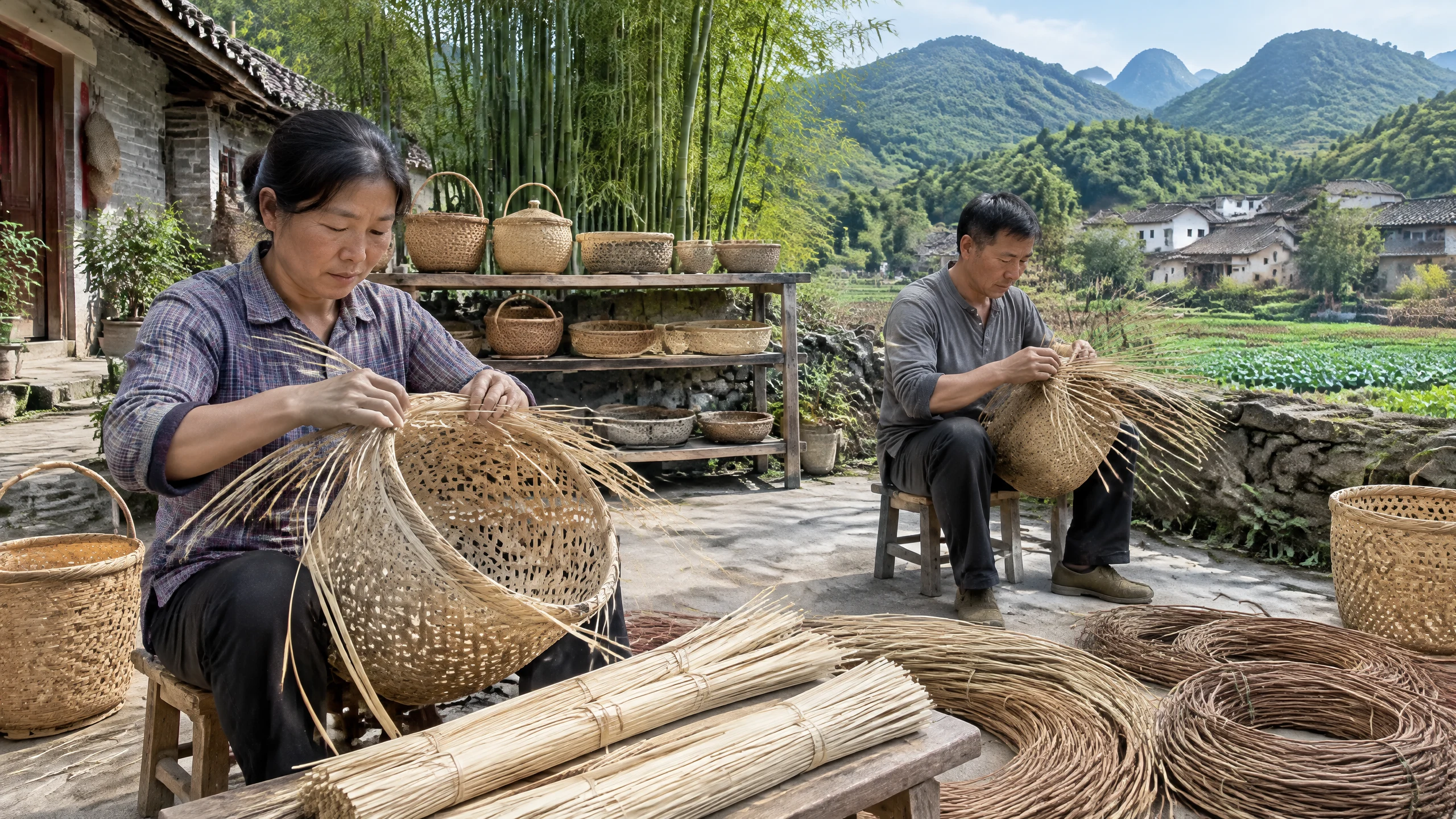
In Bobai County, Yulin, Guangxi, weaving links rural life with an international homewares industry. Bamboo splints, rattan and other plant fibres become baskets, trays, shades and decorative objects. Behind those finished products is a relationship between landscape, household skills, workshops and overseas buyers—not simply a factory production line.
A green landscape, with a careful distinction about materials
Bobai’s subtropical monsoon climate supports a rich plant landscape. Local reporting identifies bamboo and mang-type plant materials among the county’s resources, including dan bamboo and mangqi grass. Hillside vegetation, village gardens and agricultural land form the setting in which weaving skills developed. 3
It is tempting to describe every hill as a rattan-and-bamboo plantation, but that would go beyond the evidence. Bobai is a documented weaving and trading hub; not every material in a Bobai-made product necessarily grows in Bobai. Local plant resources can be combined with materials obtained through wider supply chains. We do not claim a verified plantation acreage or that JapandiWoven owns the surrounding forests.
For a buyer, this distinction matters. Ask separately where an item is woven, what plant material it contains, and where that material is sourced. An origin story becomes stronger when those answers are precise.
Rural life and skilled work close to home
The appeal of Bobai’s story is not a romantic idea of villagers untouched by modern life. It is the practical possibility of combining rural households, skilled handwork and contemporary commerce. Local reporting describes a company–base–household model, through which some residents can earn income from weaving close to home. 3
A July 2026 People’s Daily report describes both workshop employment and household weaving livelihoods, alongside design development, trade fairs and modern industrial parks. Rural craft here is not frozen in the past: experienced makers work within a changing industry that includes logistics, online sales and international customers. 2
This is a more respectful way to understand a simple, grounded lifestyle. Familiar surroundings and inherited skills can coexist with ambition, new designs and professional production. There is no need to portray every farmer as a weaver or every household as following the same daily routine.
A tradition carried through the hands
Bobai’s mang-and-bamboo weaving has a long local history. Its recognition as an autonomous-region intangible cultural heritage project in 2014 marks the importance of conserving skills as well as finished objects. The 2026 People’s Daily account describes a tradition with roots stretching back about a thousand years. 2
The continuity lies in material knowledge: how a strand bends, how tight a crossing should be, and how to keep a shape stable. At the same time, baskets and other everyday forms are being adapted for new living spaces and retail collections.
What distinguishes bamboo weaving and rattan weaving?
Bamboo weaving works with strips or splints prepared from bamboo. Depending on their thickness and the weave, these can create crisp geometry, closely woven surfaces or open patterns that filter light. Material preparation and edge finishing are important to both appearance and usability.
Rattan weaving uses material from climbing palms rather than bamboo, which is a grass. Rattan can support curves, wrapping and flowing profiles; an item may combine rattan with other materials or a separate supporting frame. The exact construction should be described product by product.
Mixed-fibre and open weaving broaden the visual language. Local reporting highlights Bobai’s so-called unordered weaving approach: an apparently free arrangement that gives contemporary objects an organic surface. Visual irregularity still requires controlled construction; it should not be confused with loose or unstable workmanship. 3
For a Japandi or wabi-sabi collection, these textures can add warmth without ornate decoration. Natural variation is part of their appeal, while smooth handling surfaces, reliable dimensions and sound construction remain non-negotiable.
What overseas buyers appreciate—and why markets differ
There is no single style that every country likes. A June 2025 local report describes one Bobai company adapting its products to European and Middle Eastern household habits, including decorative mirrors and a bread basket redesigned around Ramadan use. These are examples of market-specific development, not a survey of all consumers in those regions. 3
The same report says Bobai’s woven products reached more than 40 overseas countries in 2024. People’s Daily subsequently reported that one featured company’s products reached more than 60 countries and regions. The company figure and county-wide figure have different scopes and should not be combined into a single statistic. 2
The lesson for exporters is practical: retain the handwoven character, but adapt form, function, colour, dimensions and packaging to the intended customer. A retailer, interior designer and hotel procurement team may value the same craft for very different reasons.
The documented export picture
The latest full-year county figures verified for this article are for 2025, reported by People’s Daily on 9 July 2026: Bobai’s weaving industry recorded RMB 4.268 billion in industrial output and RMB 1.275 billion in foreign-trade exports, up 5.57% and 2.33%, respectively. These are county industry totals, not JapandiWoven sales and not solely rattan or bamboo plantation output. 2
The report also describes more than 390 weaving businesses, approximately 25,000 fixed workers and more than 200,000 temporary or seasonal participants. These categories should remain separate rather than be presented as a single permanent workforce. 2
Earlier, Xinhua reported an established chain covering material collection and preparation, design, weaving, finishing and export logistics. Together, the accounts show a substantial industry moving beyond scattered household production while retaining handcraft as an important part of its identity. 1
How JapandiWoven connects the story with sourcing
JapandiWoven is rooted in Bobai, Guangxi, bringing handwoven lighting, storage and décor to overseas buyers. Our role is to make the connection between craft and purchasing clearer: let buyers see the design, understand the material and discuss the intended use before committing to a collection.
For an overseas buyer, the most useful questions are concrete: What is the actual fibre composition? Which finish is used? How are edges and dimensions checked? How will moisture be managed in packing? Can a repeat order follow the approved sample? Claims such as certified, food-safe or compostable need product-specific evidence rather than an attractive countryside image.
Browse the JapandiWoven shop, view the Trade Lookbook, or discuss a wholesale collection. For the wider cultural background, read China’s bamboo regions and craft aesthetics.
Sources and scope
- 1 Xinhua, 27 October 2025: Bobai’s first-three-quarter industry and export performance, and its production chain.
- 2 People’s Daily, 9 July 2026: craft livelihoods, 2025 full-year industry/export totals, workforce categories and company examples.
- 3 Nanguo Morning Post, 4 June 2025: local plant resources, household production, weaving techniques and market adaptation.
Research checked on 18 November 2026. Published figures retain their reporting periods; this article does not present a 2026 full-year export total.