 JAPANDIWOVEN
China’s Bamboo Regions: A Living Culture of Bamboo Weaving and Craft Aesthetics
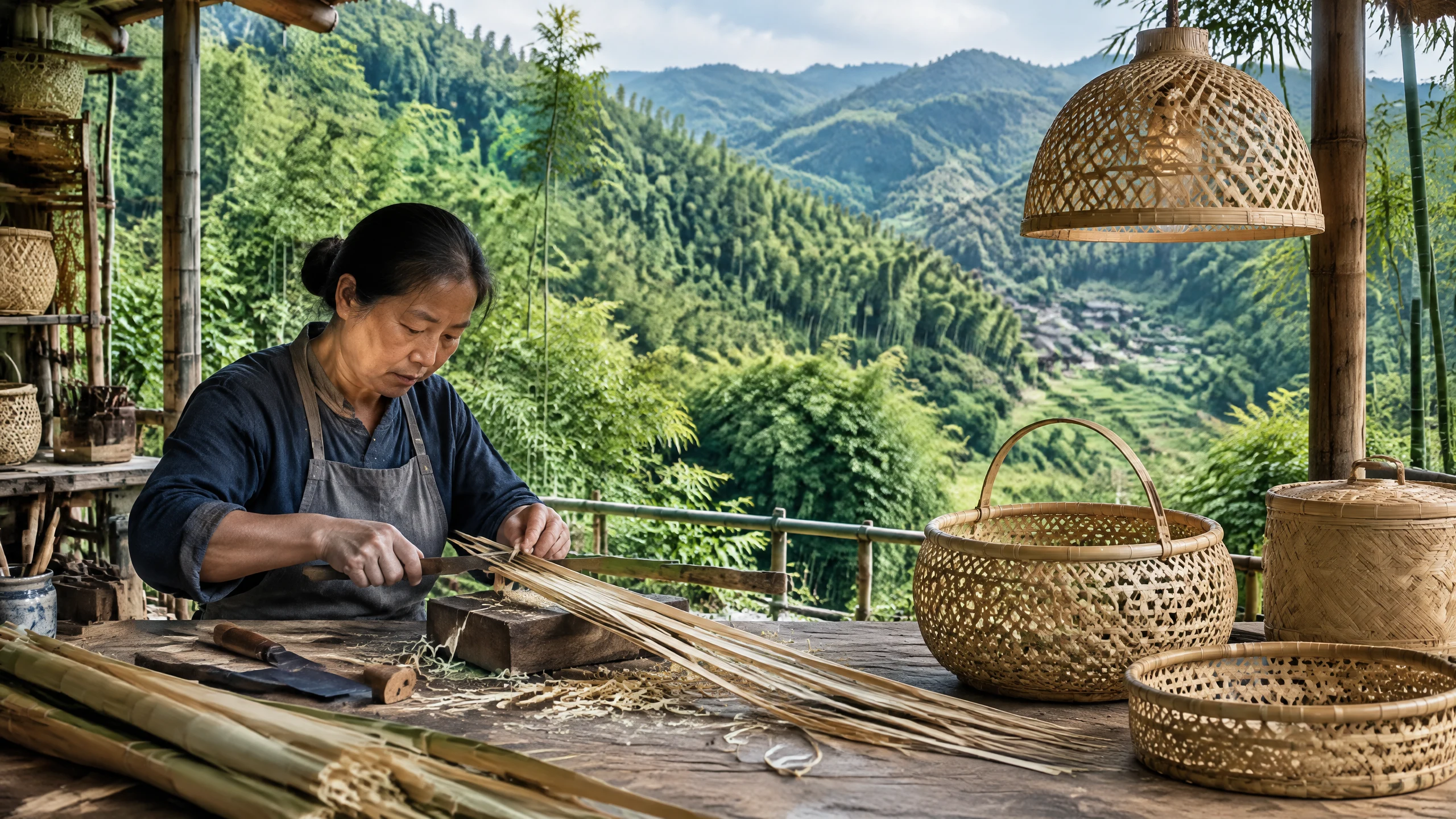
Bamboo is more than a raw material in China. It is a landscape, a household companion and a cultural language. A basket carries a harvest; a woven shade softens light; a slender stem appears in poetry and painting. To understand Chinese bamboo weaving, start with the relationship between the places that grow bamboo and the people who turn it into useful, beautiful objects.
China’s bamboo production bases are a network, not one place
China’s bamboo economy stretches across several southern provinces. Species, growing conditions and processing skills differ, so a bamboo forest, a pulp-producing district and a fine-weaving workshop should not be treated as interchangeable sources. 2
- Anji, Zhejiang: a well-known bamboo landscape and industry cluster, useful as a starting point for understanding how bamboo connects rural landscapes with manufactured products.
- Yibin, Sichuan: a major bamboo-producing region with modern bamboo forest bases and industries spanning bamboo shoots, pulp, fibre and other processed products.
- Chishui, Guizhou: a bamboo-rich region where bamboo weaving and intangible cultural heritage are connected with local livelihoods.
- Southern craft clusters, including Bobai in Guangxi: places where bamboo, rattan and other plant fibres are shaped into household objects and export collections. A weaving hub is not necessarily the growing origin of every material it uses.
The National Forestry and Grassland Administration reported that Yibin had 3.3392 million mu of bamboo forest at the end of 2022. This is a dated regional figure, not a current national total. It illustrates the scale behind a supply chain that connects forest management, harvesting and processing. 5
From everyday tools to bamboo culture
China’s relationship with bamboo reaches back to early material culture. Long before contemporary décor, bamboo served practical needs: containers, transport, shelter, writing materials and household utensils. Its cultural meaning grew alongside these everyday uses. Xinhua’s overview traces early bamboo-related evidence to Neolithic material and describes bamboo’s place in literature and the arts. 2
In painting and poetry, bamboo became associated with uprightness and resilience. It is counted among the Four Gentlemen of Chinese painting and the Three Friends of Winter. These associations do not make every basket a symbolic artwork, but they help explain why an ordinary material can carry such a rich aesthetic memory. 2
Bamboo weaving also developed through regional transmission: skills learned by observation, practice and repeated handling of the material. UNESCO and INBAR’s 2024 atlas documents bamboo-related intangible cultural heritage, weaving history, techniques and innovation. Living heritage includes adaptation, not simply preserving old shapes unchanged. 1
The craft behind the surface
A woven object begins before the first crossing of strips. Material selection, splitting and preparation influence the flexibility and finish of the splints. The maker then builds a base, raises the walls or shade profile, and finishes the rim. Techniques vary by region and intended use; very fine decorative bamboo work should not be confused with a heavier utility basket. 3
The craft’s beauty emerges from practical decisions: the width of a strip, the tension at a crossing, the spacing of an opening and the way a rim meets a handle. These are structural choices as much as visual ones.
Five craft aesthetics that still matter today
- Rhythm and geometry: repeated crossings create grids, diagonals and other patterns that make construction visible.
- Fine-line precision: carefully prepared splints can turn a simple form into a delicate surface.
- Light and shadow: open weaving lets daylight or a lamp reveal another layer of pattern.
- Material honesty: visible grain, nodes and tonal variation show the plant rather than disguising it as a uniform synthetic surface.
- Useful restraint: a balanced basket, tray or shade can be expressive without excessive ornament.
These are ways to read woven objects, not a single national style. Different workshops and traditions place different emphasis on density, ornament, colour and form.
Bamboo weaving in Japandi and wabi-sabi interiors
For contemporary buyers, bamboo’s lightness of appearance and visible handwork can complement Japandi rooms: simple forms, restrained arrangements and natural textures. Wabi-sabi offers another way to appreciate material variation and ageing. Neither label is the historical origin of Chinese bamboo weaving, and neither should excuse rough edges, weak construction or poor finishing.
Try an open bamboo shade over a quiet dining area, a closely woven tray beside ceramics, or a basket with a simple profile against linen and timber. Let the weaving provide texture while keeping the surrounding composition uncluttered.
Renewable material, responsible product decisions
Bamboo can be a renewable feedstock, but the environmental performance of a finished object also depends on harvesting, treatment, coatings, transport, durability and disposal. “Natural” does not automatically mean certified, food-safe, compostable or chemical-free. Buyers should ask for product-specific material and finish information rather than rely on a broad eco-friendly label.
JapandiWoven’s sourcing story is rooted in Bobai, Guangxi, connecting handwoven products with overseas buyers. Explore the Trade Lookbook, browse woven lighting and storage, or continue with Bobai’s village weaving and export story.
Further reading
- 1 UNESCO, 2024: overview of China’s bamboo-related intangible cultural heritage atlas.
- 2 Xinhua, 2023: China’s bamboo industry and cultural background.
- 3 UNESCO and INBAR, 2024: bamboo heritage and weaving innovation atlas.
- 5 National Forestry and Grassland Administration, 2023: Yibin bamboo industry development, with end-2022 forest figures.